#include <Authentication.h>
Public Member Functions | |
| AuthOauth2 (ParamMap ¶ms) | |
| const std::string | getAuthMethodName () const |
| Result | getAuthData (AuthenticationDataPtr &authDataOauth2) |
Static Public Member Functions | |
| static AuthenticationPtr | create (ParamMap ¶ms) |
| static AuthenticationPtr | create (const std::string &authParamsString) |
| Static Public Member Functions inherited from pulsar::Authentication | |
| static ParamMap | parseDefaultFormatAuthParams (const std::string &authParamsString) |
Additional Inherited Members | |
| Protected Attributes inherited from pulsar::Authentication | |
| AuthenticationDataPtr | authData_ |
Detailed Description
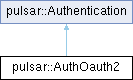
Oauth2 based implementation of Pulsar client authentication. Passed in parameter would be like:
For tokenEndpointAuthMethod = "tls_client_auth":
If passed in as std::string, it should be in Json format.
Member Function Documentation
◆ create() [1/2]
|
static |
Create an AuthOauth2 with an authentication parameter string
◆ create() [2/2]
|
static |
Create an AuthOauth2 with a ParamMap
For tokenEndpointAuthMethod = "client_secret_post" (default), the required parameter keys are “issuer_url”, “private_key”, and “audience”. Optional keys: scope, tls_cert_file, tls_key_file.
For tokenEndpointAuthMethod = "tls_client_auth", the required parameter keys are issuer_url, tls_cert_file, and tls_key_file. Optional keys: client_id, audience, scope. If client_id is omitted, the client uses pulsar-client.
- Parameters
-
parameters the key-value to create OAuth 2.0 client credentials
◆ getAuthData()
|
virtual |
Get AuthenticationData from the current instance
- Parameters
-
[out] authDataOauth2 the shared pointer of AuthenticationData. The content of AuthenticationData is changed to the internal data of the current instance.
- Returns
- ResultOk or ResultAuthenticationError if authentication failed
Reimplemented from pulsar::Authentication.
◆ getAuthMethodName()
|
virtual |
- Returns
- “token”
Implements pulsar::Authentication.
The documentation for this class was generated from the following file:
- include/pulsar/Authentication.h
Generated by
 1.15.0