Pulsar Perf
The Pulsar Perf is a built-in performance test tool for Apache Pulsar. You can use the Pulsar Perf to test message writing or reading performance. For detailed information about performance tuning, see here.
Produce messages
For the latest and complete information about pulsar-perf, including commands, flags, descriptions, and more, see pulsar-perf.
-
This example shows how the Pulsar Perf produces messages with default options.
Input
bin/pulsar-perf produce my-topicAfter the command is executed, the test data is continuously output on the Console.
Output
19:53:31.459 [pulsar-perf-producer-exec-1-1] INFO org.apache.pulsar.testclient.PerformanceProducer - Created 1 producers19:53:31.482 [pulsar-timer-5-1] WARN com.scurrilous.circe.checksum.Crc32cIntChecksum - Failed to load Circe JNI library. Falling back to Java based CRC32c provider19:53:40.861 [main] INFO org.apache.pulsar.testclient.PerformanceProducer - Throughput produced: 93.7 msg/s --- 0.7 Mbit/s --- failure 0.0 msg/s --- Latency: mean: 3.575 ms - med: 3.460 - 95pct: 4.790 - 99pct: 5.308 - 99.9pct: 5.834 - 99.99pct: 6.609 - Max: 6.60919:53:50.909 [main] INFO org.apache.pulsar.testclient.PerformanceProducer - Throughput produced: 100.0 msg/s --- 0.8 Mbit/s --- failure 0.0 msg/s --- Latency: mean: 3.437 ms - med: 3.328 - 95pct: 4.656 - 99pct: 5.071 - 99.9pct: 5.519 - 99.99pct: 5.588 - Max: 5.58819:54:00.926 [main] INFO org.apache.pulsar.testclient.PerformanceProducer - Throughput produced: 100.0 msg/s --- 0.8 Mbit/s --- failure 0.0 msg/s --- Latency: mean: 3.376 ms - med: 3.276 - 95pct: 4.520 - 99pct: 4.939 - 99.9pct: 5.440 - 99.99pct: 5.490 - Max: 5.49019:54:10.940 [main] INFO org.apache.pulsar.testclient.PerformanceProducer - Throughput produced: 100.0 msg/s --- 0.8 Mbit/s --- failure 0.0 msg/s --- Latency: mean: 3.298 ms - med: 3.220 - 95pct: 4.474 - 99pct: 4.926 - 99.9pct: 5.645 - 99.99pct: 5.654 - Max: 5.65419:54:20.956 [main] INFO org.apache.pulsar.testclient.PerformanceProducer - Throughput produced: 100.1 msg/s --- 0.8 Mbit/s --- failure 0.0 msg/s --- Latency: mean: 3.308 ms - med: 3.199 - 95pct: 4.532 - 99pct: 4.871 - 99.9pct: 5.291 - 99.99pct: 5.323 - Max: 5.32319:54:30.972 [main] INFO org.apache.pulsar.testclient.PerformanceProducer - Throughput produced: 100.0 msg/s --- 0.8 Mbit/s --- failure 0.0 msg/s --- Latency: mean: 3.249 ms - med: 3.144 - 95pct: 4.437 - 99pct: 4.970 - 99.9pct: 5.329 - 99.99pct: 5.414 - Max: 5.41419:54:40.987 [main] INFO org.apache.pulsar.testclient.PerformanceProducer - Throughput produced: 100.0 msg/s --- 0.8 Mbit/s --- failure 0.0 msg/s --- Latency: mean: 3.435 ms - med: 3.361 - 95pct: 4.772 - 99pct: 5.150 - 99.9pct: 5.373 - 99.99pct: 5.837 - Max: 5.837^C19:54:44.325 [Thread-1] INFO org.apache.pulsar.testclient.PerformanceProducer - Aggregated throughput stats --- 7286 records sent --- 99.140 msg/s --- 0.775 Mbit/s19:54:44.336 [Thread-1] INFO org.apache.pulsar.testclient.PerformanceProducer - Aggregated latency stats --- Latency: mean: 3.383 ms - med: 3.293 - 95pct: 4.610 - 99pct: 5.059 - 99.9pct: 5.588 - 99.99pct: 5.837 - 99.999pct: 6.609 - Max: 6.609From the above test data, you can get the throughput statistics and the write latency statistics. The aggregated statistics is printed when the Pulsar Perf is stopped. You can press Ctrl+C to stop the Pulsar Perf. After the Pulsar Perf is stopped, the HdrHistogram formatted test result appears under your directory. The document looks like
perf-producer-1589370810837.hgrm. You can also check the test result through HdrHistogram Plotter. For details about how to check the test result through HdrHistogram Plotter, see HdrHistogram Plotter. -
This example shows how the Pulsar Perf produces messages with the
transactionoption.Input
bin/pulsar-perf produce my-topic -r 10 -m 100 -txnOutput
2021-10-11T13:36:15,595+0800 INFO [Thread-3] o.a.p.t.PerformanceProducer@499 - --- Transaction : 2 transaction end successfully ---0 transaction end failed --- 0.200 Txn/s2021-10-11T13:36:15,614+0800 INFO [Thread-3] o.a.p.t.PerformanceProducer@503 - Throughput produced: 100 msg --- 0.0 msg/s --- 0.1 Mbit/s --- failure 0.0 msg/s --- Latency: mean: 3.067 ms - med: 3.104 - 95pct: 3.747 - 99pct: 4.619 - 99.9pct: 6.760 - 99.99pct: 6.760 - Max: 6.7602021-10-11T13:36:15,710+0800 INFO [pulsar-perf-producer-exec-46-1] o.a.p.t.PerformanceProducer@834 - Aggregated latency stats --- Latency: mean: 3.067 ms - med: 3.104 - 95pct: 3.747 - 99pct: 4.619 - 99.9pct: 6.760 - 99.99pct: 6.760 - 99.999pct: 6.760 - Max: 6.7602021-10-11T13:36:29,976+0800 INFO [Thread-4] o.a.p.t.PerformanceProducer@815 - --- Transaction : 2 transaction end successfully --- 0 transaction end failed --- 2 transaction open successfully --- 0 transaction open failed --- 12.237 Txn/s2021-10-11T13:36:29,976+0800 INFO [Thread-4] o.a.p.t.PerformanceProducer@824 - Aggregated throughput stats --- 102 records sent --- 4.168 msg/s --- 0.033 Mbit/s
Consume messages
For the latest and complete information about pulsar-perf, including commands, flags, descriptions, and more, see pulsar-perf.
-
This example shows how the Pulsar Perf consumes messages with default options.
Input
noteRun a producer while measuring consumption, or prepare a retained backlog. A new subscription starts at
Latestby default; use--subscription-position Earliestto read retained messages. Automatic topic creation depends on the broker and namespace configuration and does not create test data.bin/pulsar-perf consume my-topicAfter the command is executed, the test data is continuously output on the Console.
Output
20:35:37.071 [main] INFO org.apache.pulsar.testclient.PerformanceConsumer - Start receiving from 1 consumers on 1 topics20:35:41.150 [pulsar-client-io-1-9] WARN com.scurrilous.circe.checksum.Crc32cIntChecksum - Failed to load Circe JNI library. Falling back to Java based CRC32c provider20:35:47.092 [main] INFO org.apache.pulsar.testclient.PerformanceConsumer - Throughput received: 59.572 msg/s -- 0.465 Mbit/s --- Latency: mean: 11.298 ms - med: 10 - 95pct: 15 - 99pct: 98 - 99.9pct: 137 - 99.99pct: 152 - Max: 15220:35:57.104 [main] INFO org.apache.pulsar.testclient.PerformanceConsumer - Throughput received: 99.958 msg/s -- 0.781 Mbit/s --- Latency: mean: 9.176 ms - med: 9 - 95pct: 15 - 99pct: 16 - 99.9pct: 17 - 99.99pct: 18 - Max: 1820:36:07.115 [main] INFO org.apache.pulsar.testclient.PerformanceConsumer - Throughput received: 100.006 msg/s -- 0.781 Mbit/s --- Latency: mean: 9.316 ms - med: 9 - 95pct: 15 - 99pct: 16 - 99.9pct: 17 - 99.99pct: 17 - Max: 1720:36:17.125 [main] INFO org.apache.pulsar.testclient.PerformanceConsumer - Throughput received: 100.085 msg/s -- 0.782 Mbit/s --- Latency: mean: 9.327 ms - med: 9 - 95pct: 15 - 99pct: 16 - 99.9pct: 17 - 99.99pct: 17 - Max: 1720:36:27.136 [main] INFO org.apache.pulsar.testclient.PerformanceConsumer - Throughput received: 99.900 msg/s -- 0.780 Mbit/s --- Latency: mean: 9.404 ms - med: 9 - 95pct: 15 - 99pct: 16 - 99.9pct: 17 - 99.99pct: 17 - Max: 1720:36:37.147 [main] INFO org.apache.pulsar.testclient.PerformanceConsumer - Throughput received: 99.985 msg/s -- 0.781 Mbit/s --- Latency: mean: 8.998 ms - med: 9 - 95pct: 15 - 99pct: 16 - 99.9pct: 17 - 99.99pct: 17 - Max: 17^C20:36:42.755 [Thread-1] INFO org.apache.pulsar.testclient.PerformanceConsumer - Aggregated throughput stats --- 6051 records received --- 92.125 msg/s --- 0.720 Mbit/s20:36:42.759 [Thread-1] INFO org.apache.pulsar.testclient.PerformanceConsumer - Aggregated latency stats --- Latency: mean: 9.422 ms - med: 9 - 95pct: 15 - 99pct: 16 - 99.9pct: 98 - 99.99pct: 137 - 99.999pct: 152 - Max: 152From the output test data, you can get the throughput statistics and the end-to-end latency statistics. The aggregated statistics are printed after the Pulsar Perf is stopped. You can press Ctrl+C to stop the Pulsar Perf.
-
This example shows how the Pulsar Perf consumes messages with the
transactionoption.Input
bin/pulsar-perf consume my-topic -r 10 -txn -ss mysubName -st Exclusive -sp Earliest -ntxn 10notePrepare messages on my-topic before this example, or run a producer concurrently. Automatic topic creation depends on the broker and namespace configuration and does not create test data.
Output
2021-10-11T13:43:36,052+0800 INFO [Thread-3] o.a.p.t.PerformanceConsumer@538 - --- Transaction: 6 transaction end successfully --- 0 transaction end failed --- 0.199 Txn/s --- AckRate: 9.952 msg/s2021-10-11T13:43:36,065+0800 INFO [Thread-3] o.a.p.t.PerformanceConsumer@545 - Throughput received: 306 msg --- 9.952 msg/s -- 0.000 Mbit/s --- Latency: mean: 26177.380 ms - med: 26128 - 95pct: 30531 - 99pct: 30923 - 99.9pct: 31021 - 99.99pct: 31021 - Max: 310212021-10-11T13:43:59,854+0800 INFO [Thread-5] o.a.p.t.PerformanceConsumer@579 - -- Transaction: 10 transaction end successfully --- 0 transaction end failed --- 10 transaction open successfully --- 0 transaction open failed --- 0.185 Txn/s2021-10-11T13:43:59,854+0800 INFO [Thread-5] o.a.p.t.PerformanceConsumer@588 - Aggregated throughput stats --- 505 records received --- 9.345 msg/s --- 0.000 Mbit/s--- AckRate: 9.27065308842743 msg/s --- ack failed 4 msg2021-10-11T13:43:59,882+0800 INFO [Thread-5] o.a.p.t.PerformanceConsumer@601 - Aggregated latency stats --- Latency: mean: 50593.000 ms - med: 50593 - 95pct: 50593 - 99pct: 50593 - 99.9pct: 50593 - 99.99pct: 50593 - 99.999pct: 50593 - Max: 50593
Transactions
This section shows how Pulsar Perf runs transactions. For more information, see Pulsar transactions.
Use transaction
This example executes 50 transactions. Each transaction sends and receives 1 message (default).
Input
bin/pulsar-perf transaction --topics-c myConsumerTopic --topics-p MyproduceTopic -threads 1 -ntxn 50 -ss testSub -nmp 1 -nmc 1
Prepare messages on myConsumerTopic before this example, or run a producer concurrently. Creating the consumer topic does not create test data.
Output
2021-10-11T14:37:27,863+0800 INFO  [Thread-5] o.a.p.t.PerformanceProducer@613 - Messages ack aggregated latency stats --- Latency: mean:  29.239 ms - med:  26.799 - 95pct:  46.696 - 99pct:  55.660 - 99.9pct:  55.660 - 99.99pct:  55.660 - 99.999pct:  55.660 - Max:  55.660 {}

2021-10-11T14:37:19,391+0800 INFO  [Thread-4] o.a.p.t.PerformanceProducer@525 - Throughput transaction:      50 transaction executes ---   4.999 transaction/s  ---send Latency: mean:  31.368 ms - med:  28.369 - 95pct:  55.631 - 99pct:  57.764 - 99.9pct:  57.764 - 99.99pct:  57.764 - Max:  57.764---ack Latency: mean:  29.239 ms - med:  26.799 - 95pct:  46.696 - 99pct:  55.660 - 99.9pct:  55.660 - 99.99pct:  55.660 - Max:  55.660 {}

2021-10-11T14:37:26,625+0800 INFO  [Thread-5] o.a.p.t.PerformanceProducer@571 - Aggregated throughput stats --- 50 transaction executed ---   2.718 transaction/s  --- 50 transaction open successfully --- 0 transaction open failed --- 50 transaction end successfully --- 0 transaction end failed--- 0 message ack failed --- 0 message send failed--- 50 message ack success --- 50 message send success  {}
Disable Transaction
This example disables transactions.
Input
bin/pulsar-perf transaction --topics-c myConsumerTopic --topics-p myproduceTopic -threads 1 -ntxn 50 -ss testSub --txn-disEnable
Prepare messages on myConsumerTopic before this example, or run a producer concurrently. Disabling transactions does not remove the need for consumer input.
Output
2021-10-11T16:48:26,876+0800 INFO  [Thread-4] o.a.p.t.PerformanceProducer@529 - Throughput task:      50 task executes ---   4.999 task/s  ---send Latency: mean:  10.002 ms - med:   9.875 - 95pct:  11.733 - 99pct:  15.995 - 99.9pct:  15.995 - 99.99pct:  15.995 - Max:  15.995---ack Latency: mean:   0.051 ms - med:   0.020 - 95pct:   0.059 - 99pct:   1.377 - 99.9pct:   1.377 - 99.99pct:   1.377 - Max:   1.377

2021-10-11T16:48:29,222+0800 INFO  [Thread-5] o.a.p.t.PerformanceProducer@617 - Messages ack aggregated latency stats --- Latency: mean:   0.051 ms - med:   0.020 - 95pct:   0.059 - 99pct:   1.377 - 99.9pct:   1.377 - 99.99pct:   1.377 - 99.999pct:   1.377 - Max:   1.377

2021-10-11T16:48:29,246+0800 INFO  [Thread-5] o.a.p.t.PerformanceProducer@629 - Messages send aggregated latency stats --- Latency: mean:  10.002 ms - med:   9.875 - 95pct:  11.733 - 99pct:  15.995 - 99.9pct:  15.995 - 99.99pct:  15.995 - 99.999pct:  15.995 - Max:  15.995

2021-10-11T16:48:29,117+0800 INFO  [Thread-5] o.a.p.t.PerformanceProducer@602 - Aggregated throughput stats --- 50 task executed --- 4.025 task/s --- 0 message ack failed --- 0 message send failed--- 50 message ack success --- 50 message send success
Configurations
By default, the Pulsar Perf uses conf/client.conf as the default configuration and uses conf/log4j2.yaml as the default Log4j configuration. If you want to connect to other Pulsar clusters, you can update the brokerServiceUrl in the client configuration.
You can use the following commands to change the configuration file and the Log4j configuration file.
export PULSAR_CLIENT_CONF=<your-config-file>
export PULSAR_LOG_CONF=<your-log-config-file>
JVM memory and garbage collection
pulsar-perf accepts PULSAR_MEM from the caller's environment. Export it or set it for the command; changing its default in conf/pulsar_env.sh does not configure the performance tool. Leave PULSAR_GC unset to retain the tool's default collector behavior. The tool does not inherit the broker's garbage-collector defaults from conf/pulsar_env.sh. For example, after configuring Linux THP settings:
PULSAR_MEM='-Xms1g -Xmx1g -XX:MaxDirectMemorySize=2g -XX:+UseTransparentHugePages -XX:+AlwaysPreTouch' \
bin/pulsar-perf produce persistent://public/default/perf --memory-limit 1G
Choose memory sizes for your workload and available resources. The --memory-limit option controls the Pulsar client's memory budget separately from the JVM heap and direct-memory limits. By default, this client budget is half the JVM's maximum direct memory; use 0 to disable the client budget.
Use PULSAR_EXTRA_OPTS for additional JVM options. These options are appended after PULSAR_MEM and PULSAR_GC. The script does not automatically apply PULSAR_GC_LOG; to enable GC logging, pass the JVM logging options through PULSAR_EXTRA_OPTS.
Isolated v4 clients
For v4 produce and consume, --isolated-clients N creates N clients and distributes the producers or consumers among them. For example, this command uses eight clients for eight producers on the topic:
bin/pulsar-perf produce persistent://public/default/perf \
  --client-api V4 --num-producers 8 --isolated-clients 8
The clients have separate connections and client memory budgets, while sharing thread pools and other client resources. Account for the combined memory budgets when sizing the JVM. For producers, keep --num-test-threads at its default of 1. For consumers, keep --num-listener-threads at 1; isolated clients cannot be combined with transaction-enabled consumption. The option is unavailable with v5.
Select the client API
The message production, consumption, reading, and transaction commands select the v5 client for topic:// scalable topics and the v4 client for persistent://, non-persistent://, and unprefixed topic names. Set --client-api V5 explicitly to benchmark a regular persistent topic with v5.
All v5 client connections require scalableTopicsEnabled=true on the brokers, including connections to regular persistent topics. Review the upgrade guidance before enabling this feature during an upgrade.
One invocation cannot mix topic:// topics with regular topic names, even with --client-api V5. In transaction benchmarks this applies to the combined producer and consumer topic lists. Direct segment:// targets are rejected. Use the ordinary command with --client-api V4 to select the v4 client.
The selected API affects benchmark semantics and options:
- v5
consumeuses a Queue consumer by default, with shared work distribution and individual acknowledgment.--subscription-type ExclusiveorFailoverdoes not select the corresponding v4 consumer behavior. Select--scalable-consumer-type Streamfor ordered consumption and cumulative acknowledgment. This option is v5-only. When running several consumers per subscription, also choose a non-Exclusive--subscription-typebecause the command validates that Exclusive permits only one consumer. - v5
readuses independent Checkpoint consumers and accepts--start-message-id earliestorlatest. AledgerId:entryIdstart position requires v4. Checkpoint consumers do not create durable subscription backlog; configure retention for data you want them to read. - v5 Stream consumers preserve per-key ordering across segment changes; they do not provide a total order across the topic.
--receiver-queue-sizeconfigures v5 Queue consumers and has no effect on the Stream consumer. - Help groups options by API. Explicitly supplying a v4-only option with v5 (or a v5-only option with v4) fails validation. For example, v5 producers use
--memory-limitinstead of the v4-only--max-outstandingand--max-outstanding-across-partitionsoptions. Match the consumer model and buffering settings when comparing API performance.
The common flags --stats-interval-seconds, --max-lookup-request, and --busy-wait are accepted with v5 but have no effect on its client. Perf disables its v5 client's OpenTelemetry SDK and exposes no v5 lookup-limit or busy-wait setting. Perf's own throughput and latency output remains available.
For example, to run eight ordered consumers on a scalable topic:
bin/pulsar-perf consume topic://public/default/perf \
  --scalable-consumer-type Stream --subscription-type Shared \
  --num-consumers 8 --subscriptions perf-stream --subscription-position Earliest
Here --scalable-consumer-type Stream selects the v5 consumer model. Consumer counts can drive segment splits or entry-bucket increases according to the topic's auto-scaling policy.
For transaction runs, --scalable explicitly creates the producer and consumer topics through the scalable admin API; --scalable-segments sets their initial segment count. Use topic:// names to select v5 automatically. --scalable cannot be combined with --partitions. The broker must also have transaction support configured, and the consumer topics need data to process. v5 transaction benchmarks use Queue consumers. Their acknowledgment latency measures the local acknowledgment call, so it is not directly comparable with the broker round-trip acknowledgment latency measured by v4.
For encrypted v5 benchmarks, producers use --encryption-key-name and --encryption-key-value-file for a PEM public key. The v5 perf consumer registers its private-key file under that file's basename, so the producer's key name must match the basename passed in the consumer's --encryption-key-value-file. Encryption disables v5 producer batching; account for this when comparing throughput.
Interpret latency results
pulsar-perf histograms use three significant digits. Producer send and transaction send/acknowledgment samples are recorded in microseconds and capped at one hour. Consumer and reader latency samples are recorded in milliseconds and capped at ten days. Values above these limits appear at the limit in the histogram. The printed latency statistics use milliseconds.
Consumer and reader latency is the difference between receipt time and the message's publish timestamp. It includes time spent in backlog and depends on the clocks of the producer and consumer. Negative samples are excluded, so clock skew can affect both the latency values and the number of samples. Use comparable clocks, backlog, warmup, and histogram precision when comparing runs.
Docker scenario framework
The Pulsar source repository also includes a performance scenario framework for repeatable experiments across revisions. Its IoT telemetry workload uses v4 Java clients with Key_Shared subscriptions and key-based batching. It checks delivery and ordering for each device, and can restart consumer pods during the run.
After following the framework's prerequisites, run a small scenario from the source repository root:
./gradlew :tests:performance:launcher:run \
  --args='--scenario tests/performance/scenarios/iot-telemetry-small.yaml'
The task builds the required test images and workload applications. Successful runs write Markdown and HTML reports under build/performance, including throughput, latency, and correctness results. Metrics collection is enabled by default; a metrics collection failure is reported and the workload can continue. See running scenarios for configuration overrides and run reports for the outputs.
For the IoT workload, warmup traffic remains part of the delivery and ordering checks, but is excluded from measured throughput and latency. Each warmup round drains outstanding sends and waits for every application to receive its messages before proceeding. Profile measurement windows extend from the first measured send through the last measured receipt across applications. See the IoT workload settings for time-based or message-count warmup, rounds, and delays.
Compare repeated runs using the same scenario and harness configuration; the framework does not automatically decide whether a revision regresses. Follow the revision comparison guide, including its distinction between changing the cluster image and changing the workload's client. The separate profile task captures JFR and CPU/off-CPU profiles. It can change the Docker host's kernel settings through a privileged container, so follow the profiling requirements and host configuration guide before using it.
Use the profile analysis guide to inspect saved recordings and collapsed stacks. The :tests:performance:report-tool:runJonoffcpuCorrelator and :tests:performance:report-tool:runJfrConverter tasks run the pinned analysis tools without starting a test cluster. Keep unprofiled measurements separate from diagnostic runs with profiling or heap dumps when assessing performance changes.
HdrHistogram Plotter
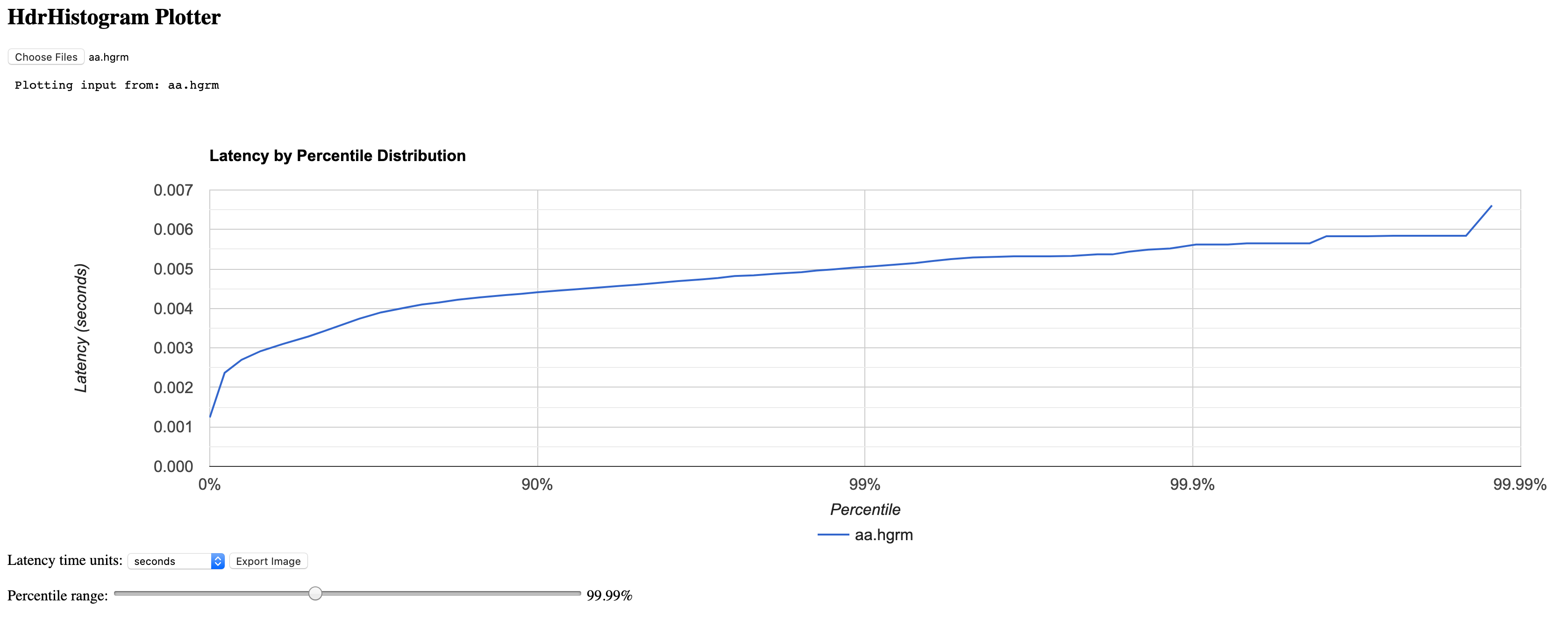
The HdrHistogram Plotter is a visualization tool for checking Pulsar Perf test results, which makes it easier to observe the test results.
To check test results through the HdrHistogram Plotter, follow these steps:
-
Clone the HdrHistogram repository from GitHub to the local.
git clone https://github.com/HdrHistogram/HdrHistogram.git -
Switch to the HdrHistogram folder.
cd HdrHistogram -
Install the HdrHistogram Plotter.
mvn clean install -DskipTests -
Transform the file generated by the Pulsar Perf.
./HistogramLogProcessor -i <hgrm file path that pulsar-perf generated> -o <output file> -
You will get two output files. Upload the output file with the filename extension of .hgrm to the HdrHistogram Plotter.
-
Check the test result through the Graphical User Interface of the HdrHistogram Plotter, as shown below.